The Jumpmaster Performance Recovery Doctrine

ARMOR & INTIMACY: A Field Manual for Intimacy and Sacred Resilience
ARMOR & INTIMACY is a raw, practical manual centered on first responder support, designed for couples living under pressure. It speaks directly to the realities of trauma, stress, emotional shutdown, duty, intimacy, faith, and the difficulty of coming home after carrying the weight of the job.
This book is not a soft relationship guide. It is a direct and honest manual for couples who love deeply but are often stretched thin by the demands of service, sacrifice, and survival mode.
The central message is simple:
You cannot protect everyone else while neglecting the life, love, and connection waiting for you at home.
The book begins with “The Weight You Carry and the Life You Come Home To,” setting the foundation for understanding how first responders often bring invisible burdens into their relationships. It acknowledges the emotional residue of the job and challenges readers to stop letting silence, stress, and survival mode define their intimacy.
Part I: Raw Intimacy and Physical Connection addresses the physical side of relationships with honesty and urgency. These chapters challenge couples to move beyond routine, disconnected sex and rediscover intimacy as teamwork, safety, grounding, affection, and emotional presence.
Part II: The Reality of the Job and the Relationship focuses on rebuilding intentional connection and includes performance recovery strategies. It explores dating your partner again, guided exercises for couples, communication after difficult calls, and the process of rebuilding trust after trauma, silence, or emotional distance.
Part III: Strength, Conflict, and Growth teaches couples how to handle tension without collapse and how to build emotional resilience together, crucial for trauma-informed recovery. It emphasizes that conflict does not have to destroy connection when couples learn to regulate, communicate, and stay engaged.
Part IV: Identity, Leadership, and Long-Term Intimacy challenges first responders to separate who they are from what they do. It calls them to lead at home, pursue long-term intimacy, align purpose with relationship, and recognize when they need help instead of carrying everything alone.
The conclusion, “The Life You Protect Should Include Your Own,” brings the message home: strength is not isolation, intimacy is not weakness, and asking for help is not failure.
ARMOR & INTIMACY is ultimately a call to return home fully—not just physically, but emotionally, spiritually, and relationally.

After the Call The Jumpmaster Performance Recovery Program
After the Call is a structured, trauma-informed recovery system specifically designed for those who serve on the front lines and behind the scenes—law enforcement, fire/EMS, dispatchers, and military personnel and veterans. This first responder support program addresses a critical gap: what happens after the call, the incident, or the mission. While training prepares individuals to respond, far fewer systems exist to aid in their performance recovery, recalibration, and sustained long-term well-being.
After the Call bridges that gap by integrating trauma-informed recovery strategies with the unique operational culture of high-performance professions. The program provides practical, real-world tools that meet the demands and realities these professionals face daily.
Core Focus Areas:
- Nervous System Stabilization – Regulating stress responses and restoring baseline function;
- Trauma Processing – Addressing cumulative and critical incident exposure at the root level;
- Identity & Purpose Rebuilding – Strengthening personal and professional alignment beyond the uniform;
- Performance Optimization – Enhancing resilience, clarity, and sustained operational readiness.
Unlike traditional approaches that isolate clinical care from job realities, this program combines both elements—creating a relatable, applicable, and effective model for first responder support.
Program Delivery Options:
- Department Contracts – Scalable solutions for agencies and organizations;
- Small Group Intensives – Focused, high-impact cohort experiences;
- Individual Sessions – Personalized recovery and performance support.
After the Call is designed to yield measurable outcomes—improving not just recovery but also long-term effectiveness, retention, and quality of life for those it serves.
Outcome-focused. Real-world. Mission-driven.
For agencies ready to support their personnel beyond the call, let’s have that conversation.
Tactical Jenga
Tactical Jenga™
When Life Pulls the Blocks Out, We Learn How to Rebuild the Tower
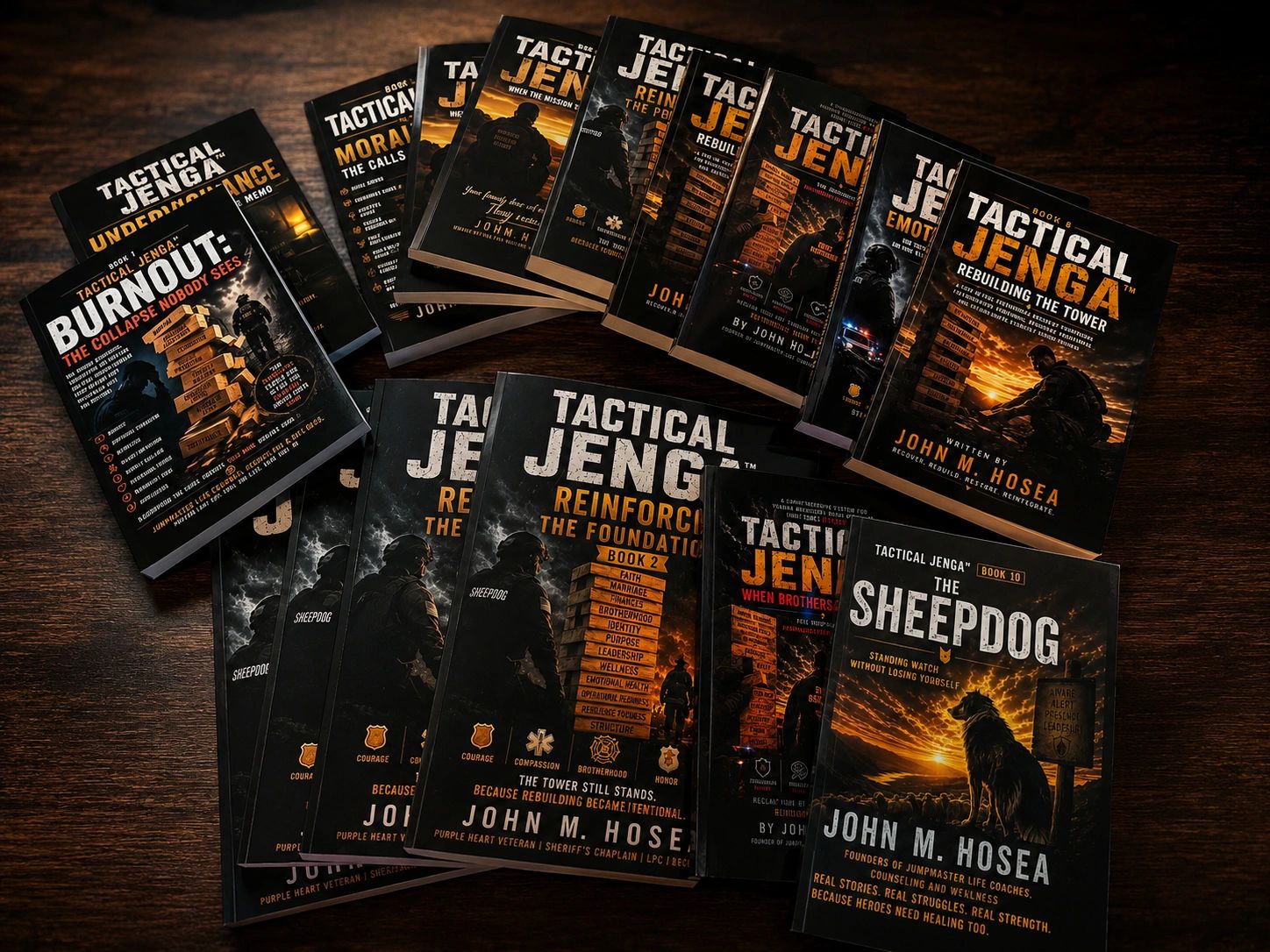
Tactical Jenga™ is more than a collection of books about trauma, stress, or mental health. It is a comprehensive performance-recovery system built around a simple but powerful idea: a person's life is like a Jenga tower.
Every person has blocks that support the structure of their life. Those blocks include physical health, mental health, sleep, relationships, marriage, family, faith, identity, purpose, leadership, emotional regulation, nutrition, friendships, financial stability, confidence, and connection to a team or community.
Those blocks are constantly under pressure for first responders, military personnel, veterans, dispatchers, corrections officers, firefighters, EMS professionals, crisis negotiators, chaplains, and others who operate in high-stress environments.
A single critical incident may remove a block.
A deployment may remove another.
The death of a teammate may remove another.
A bad call may remove another.
Then come sleep deprivation, chronic pain, hypervigilance, relationship problems, organizational betrayal, moral injury, burnout, isolation, anger, depression, loss of faith, or the feeling that nobody outside the profession understands.
Eventually, the question becomes:
How many blocks can be removed before the tower becomes unstable?
That is the foundation of Tactical Jenga™.
The model does not look at a struggling first responder and ask only, "What is wrong with you?"
Instead, it asks:
"What blocks have been removed?"
"Which blocks are carrying too much weight?"
"Which parts of the tower are beginning to lean?"
"What is still holding you up?"
And, most importantly:
"How do we intentionally rebuild the tower?"
This whole-person approach is also how Tactical Jenga™ is described by Jumpmaster Life Coaches, Counseling and Wellness: trauma does not affect only one area of life; it can affect the entire "tower," including performance, resilience, relationships, faith, physical health, emotional regulation, identity, sleep, nutrition, leadership, and purpose.
Why Tactical Jenga™ Was Created
Traditional approaches to mental health can sometimes separate problems into individual categories.
Anxiety is treated as anxiety.
Depression is treated as depression.
PTSD is treated as PTSD.
Marriage problems are treated as marriage problems.
Sleep problems are treated as sleep problems.
Burnout is treated as burnout.
Tactical Jenga™ challenges us to look at how those problems may be connected.
An officer may be irritable because he is experiencing hypervigilance.
A firefighter may be emotionally detached because she has spent years compartmentalizing traumatic calls.
A veteran may be struggling in a marriage because the survival behaviors that worked during deployment never completely shut off after coming home.
A dispatcher may believe she is burned out when cumulative exposure to other people's worst moments has slowly removed multiple blocks from her tower.
A negotiator may successfully manage everyone else's crisis while quietly ignoring his own.
The symptom we see may therefore be only the visible movement of the tower.
Tactical Jenga™ goes deeper and asks what caused the instability.
That is why the complete series is designed as a progression rather than twelve unrelated books.
How the 12 Tactical Jenga™ Books Work Together
The twelve books should be viewed as one recovery library.
A reader does not necessarily have to be experiencing every problem covered by every volume. Instead, each book examines another part of the tower and provides another opportunity to identify, understand, restore, or reinforce an important block.
Book 1 — Tactical Jenga™: A Jumpmaster Performance Recovery Doctrine
Book 1 establishes the foundation.
It introduces the Tactical Jenga™ concept and teaches readers to look at themselves as a complete system rather than a collection of symptoms.
This is where readers begin identifying their blocks:
What keeps me strong?
What has trauma removed?
Where has my performance changed?
What am I ignoring because I can still function?
What happens if another block gets pulled?
Book 1 establishes the philosophy behind the entire series: functioning is not always the same thing as being healthy.
Someone can still put on a uniform, answer calls, supervise people, raise children, lead a team, and complete the mission while their internal tower is becoming increasingly unstable.
The goal is to identify that instability before complete collapse.
Book 2 — When the Mission Follows You Home
The uniform may come off, but the nervous system does not always recognize that the mission has ended.
This book examines what happens when occupational survival behaviors enter the home.
Command presence can become control.
Situational awareness can become hypervigilance.
Emotional compartmentalization can become emotional distance.
Decisiveness can become impatience.
Mission focus can become family disconnection.
The behaviors that help someone survive professionally can sometimes damage relationships personally.
Book 2 addresses the difficult transition between protector and spouse, warrior and parent, responder and human being.
The goal is not to eliminate the protector.
It is to teach the protector how to come home.
Book 3 — When Brotherhood Breaks
One of the strongest protective factors in high-risk professions is connection to the team.
But what happens when that connection disappears?
What happens when a teammate betrays you?
When leadership abandons you?
When an organization you sacrificed for suddenly treats you like a liability?
When the people who once said, "I've got your six," are no longer standing behind you?
This book examines organizational betrayal, broken trust, isolation, team conflict, leadership failures, and the emotional consequences of losing the brotherhood or sisterhood that once provided identity and belonging.
Published listings identify When Brotherhood Breaks as part of the Tactical Jenga™ series.
The block being rebuilt here is trust and connection.
Book 4 — Hypervigilance: The Body Never Got the Memo
The call ended.
The deployment ended.
The threat disappeared.
But the body never received the message.
Book 4 examines the physiological side of operational stress.
Why can't I relax?
Why do I always scan the room?
Why do crowds bother me?
Why do I sit where I can see the door?
Why am I exhausted but unable to sleep?
Why does a small sound cause an immediate physical reaction?
Why do I feel uncomfortable when everything is quiet?
Hypervigilance is not simply "thinking too much." The nervous system may have learned that constant readiness equals survival.
Published listings confirm Hypervigilance: The Body Never Got the Memo as Book 4 of Tactical Jenga™.
This volume helps readers understand the difference between being prepared for danger and living as though danger never ends.
Book 5 — Moral Injury: The Calls That Never Leave
Some experiences hurt because of what happened.
Others hurt because of what they meant.
Moral injury can occur when someone witnesses, participates in, fails to prevent, or feels betrayed by something that violates deeply held beliefs.
For first responders and military personnel, these may become the calls, missions, faces, decisions, or outcomes that never completely disappear.
Book 5 addresses guilt, shame, responsibility, forgiveness, faith, grief, and the difficult question:
"Did I do enough?"
Published listings identify Book 5 as Moral Injury: The Calls That Never Leave.
This book helps rebuild the blocks of meaning, forgiveness, faith, and self-worth.
Book 6 — The Hidden Weight of Service
Book 6 moves deeper into cumulative operational stress—the weight that builds when there is no single incident responsible for someone's struggles.
Sometimes there is no "one bad call."
There are hundreds.
There are years of seeing death.
Years of delivering bad news.
Years of violence.
Years of child-abuse cases.
Years of crashes.
Years of suicides.
Years of listening to screaming through a headset.
Years of being expected to remain composed while everyone else is allowed to fall apart.
Eventually, the accumulation itself becomes the injury.
Book 6 helps readers recognize the blocks that have been slowly weakened rather than suddenly removed.
Book 7 — Burnout: The Collapse Nobody Sees
Burnout rarely announces itself dramatically.
It often begins quietly.
Less patience.
Less motivation.
More cynicism.
Poor sleep.
Emotional exhaustion.
Isolation.
Loss of empathy.
Anger.
Reduced performance.
A growing sense of:
"I just don't care anymore."
For high performers, burnout can be particularly dangerous because they may continue functioning long after they should have asked for help.
Book 7 examines the difference between being tired and becoming depleted.
Published book listings confirm Book 7 as part of the Tactical Jenga™ series.
The mission of this volume is to recognize collapse before the tower hits the ground.
Book 8 — Rebuilding the Tower
This is where Tactical Jenga™ deliberately changes direction.
Identifying damage is important.
Understanding trauma is important.
Recognizing burnout is important.
But eventually recovery must become intentional.
Book 8 asks: What are we going to rebuild?
Rebuilding the Tower provides an implementation framework organized around stabilization, processing, restoration, and reintegration. Its published description specifically addresses sleep and nervous-system regulation, trauma processing and EMDR integration, relationships, identity, spiritual health, purpose, leadership, and sustainable wellness.
The four phases are:
Stabilization
Get the tower stable.
Processing
Address what happened.
Restoration
Put important blocks back into the structure.
Reintegration
Return to family, leadership, service, relationships, and purpose without returning to the same unhealthy patterns.
The goal is not simply to rebuild the old tower.
Build a stronger one.
Book 9 — Reinforce the Foundation
Once the tower has been rebuilt, another question becomes important:
How do we keep it standing?
Book 9 moves from recovery toward sustainability.
Readers examine multiple areas of life and determine where continued reinforcement is necessary.
The purpose is preventative maintenance.
You do not wait until an aircraft crashes to perform maintenance.
You do not wait until a weapon fails during a mission to inspect it.
You do not wait until a parachute malfunction to care about rigging.
Human performance should receive the same attention.
Book 9 therefore focuses on assessing the foundation, recognizing vulnerabilities, developing short- and long-term sustainability strategies, and creating a personal legacy plan.
Recovery becomes something you maintain, not simply something you complete.
Book 10 — The Sheepdog: Standing Watch Without Losing Yourself
Some people are naturally drawn toward protecting others.
Military.
Law enforcement.
Fire.
EMS.
Corrections.
Dispatch.
Negotiators.
Chaplains.
Counselors.
Leaders.
Protecting people can become more than a profession.
It can become an identity.
But there is a danger when the protector believes everyone deserves protection except the protector.
Book 10 examines the sheepdog mindset, vigilance, leadership, depression, anxiety, family, faith, betrayal, wellness, retirement, identity, and the psychological cost of constantly standing watch.
Its central question is:
How do you remain capable of protecting others without destroying yourself in the process?
Book 11 — Armor & Intimacy™
After trauma and years of operational exposure, emotional armor can become incredibly effective.
That armor may protect someone from fear.
Pain.
Loss.
Grief.
Betrayal.
But armor has a problem.
Armor does not know the difference between an enemy and someone trying to love you.
Book 11 examines relationships, emotional availability, marriage, intimacy, communication, vulnerability, trust, and reconnection.
The objective is not to remove every piece of armor.
It is learning when it is safe to take it off.
A first responder may need armor at 2:00 p.m. during a critical incident.
That same armor may create distance at 8:00 p.m. sitting beside a spouse.
Book 11 helps rebuild the relational blocks of the tower.
Book 12 — After the Call™
The final book asks perhaps the most important question in the entire series:
What happens after the call?
Everyone prepares for the call.
Training.
Equipment.
Policies.
Tactics.
Leadership.
Communications.
Medical response.
Negotiation.
But comparatively little attention is sometimes given to the human being who drives home afterward.
After the adrenaline disappears.
After everyone stops calling.
After the funeral.
After the investigation.
After retirement.
After the uniform gets hung in the closet for the final time.
Who are you after the call?
Book 12 brings the Tactical Jenga™ system together by focusing on long-term recovery, family, purpose, identity, connection, faith, leadership, legacy, and life beyond the profession.
The ultimate objective is not simply surviving a career.
It is having a life worth living when the career is over.
How All 12 Books Form One System
The progression can be understood simply:
Books 1–3: Identify the Tower
Understand your foundation, recognize what service has changed, and examine the importance of relationships and brotherhood.
Books 4–7: Understand What Pulls the Blocks
Hypervigilance, moral injury, cumulative stress, trauma, organizational problems, and burnout explain why apparently strong people can become unstable.
Books 8–9: Rebuild and Reinforce
Move beyond awareness into intentional recovery, reconstruction, resilience, and long-term maintenance.
Books 10–12: Protect the Future
Learn how to remain a protector without losing yourself, reconnect with the people you love, and build an identity, purpose, and legacy that continue after the mission ends.
That is what makes Tactical Jenga™ different.
It is not twelve books about twelve problems.
It is one system examining one human being from twelve interconnected directions.
Who Tactical Jenga™ Is For
Tactical Jenga™ was developed with the high-performance and service communities in mind, including law enforcement officers, firefighters, paramedics, EMTs, dispatchers, corrections professionals, military personnel, veterans, SWAT personnel, crisis and hostage negotiators, chaplains, emergency managers, counselors, mental-health professionals, spouses, families, supervisors, command staff, and anyone carrying the accumulated weight of service.
You do not have to wait until the tower collapses.
That may be one of the most important principles in the entire Tactical Jenga™ system.
Mental-health maintenance should occur before crisis, not only after it.
How to Get the Tactical Jenga™ Books on Amazon
The Tactical Jenga™ books are published through Amazon's KDP ecosystem; for example, Rebuilding the Tower is listed as published by Amazon Digital Services LLC – KDP, and public book listings show multiple Tactical Jenga™ volumes under author John M. Hosea.
To find the books:
- Go to Amazon Books.
- In the search bar, type John M. Hosea Tactical Jenga.
- You can also search the individual title, such as Tactical Jenga Rebuilding the Tower John M. Hosea.
- Look for John M. Hosea as the author so you are selecting the correct Tactical Jenga™ title.
- Select the available format and order directly through Amazon.
Search Amazon for John M. Hosea Tactical Jenga™.
The series is also described through the official Jumpmaster Life Coaches, Counseling, and Wellness website under its Tactical Jenga Books and Classes material.
Jumpmaster Life Coaches, Counseling and Wellness
The Tactical Jenga™ Mission
The mission behind Tactical Jenga™ is not to convince first responders, veterans, or other high performers that they are weak.
It is to teach them to recognize load.
A Jenga tower does not collapse because it lacks courage.
It collapses because too many structural pieces have been removed without being replaced.
Human beings are not much different.
Every critical incident can pull a block.
Every loss can pull a block.
Every betrayal can pull a block.
Every sleepless night can weaken a block.
Every argument can move another.
Every deployment can change the structure.
Every time someone says, "I'm fine," when they know they are not, another warning sign can go unnoticed.
But Tactical Jenga™ carries an equally important message:
Blocks can be replaced.
Sleep can improve.
Relationships can heal.
Trauma can be processed.
Faith can be restored.
Purpose can return.
Trust can be rebuilt.
Families can reconnect.
Leaders can become healthier.
Protectors can learn to protect themselves.
And people can discover that asking for help does not end the mission.
Sometimes it is what allows the mission to continue.
The Tactical Jenga™ Philosophy
The tower does not have to fall before we start putting the blocks back.
And even when it does fall, collapse does not have to be the end of the story.
We stabilize.
We process.
We restore.
We rebuild.
We reinforce.
We reconnect.
And then we return to the mission differently—not pretending that nothing happened, but understanding what happened and building something stronger from it.
Because recovery is not the end of the mission.
Recovery is the beginning of the next one.
The Jumpmaster Performance Recovery Program